
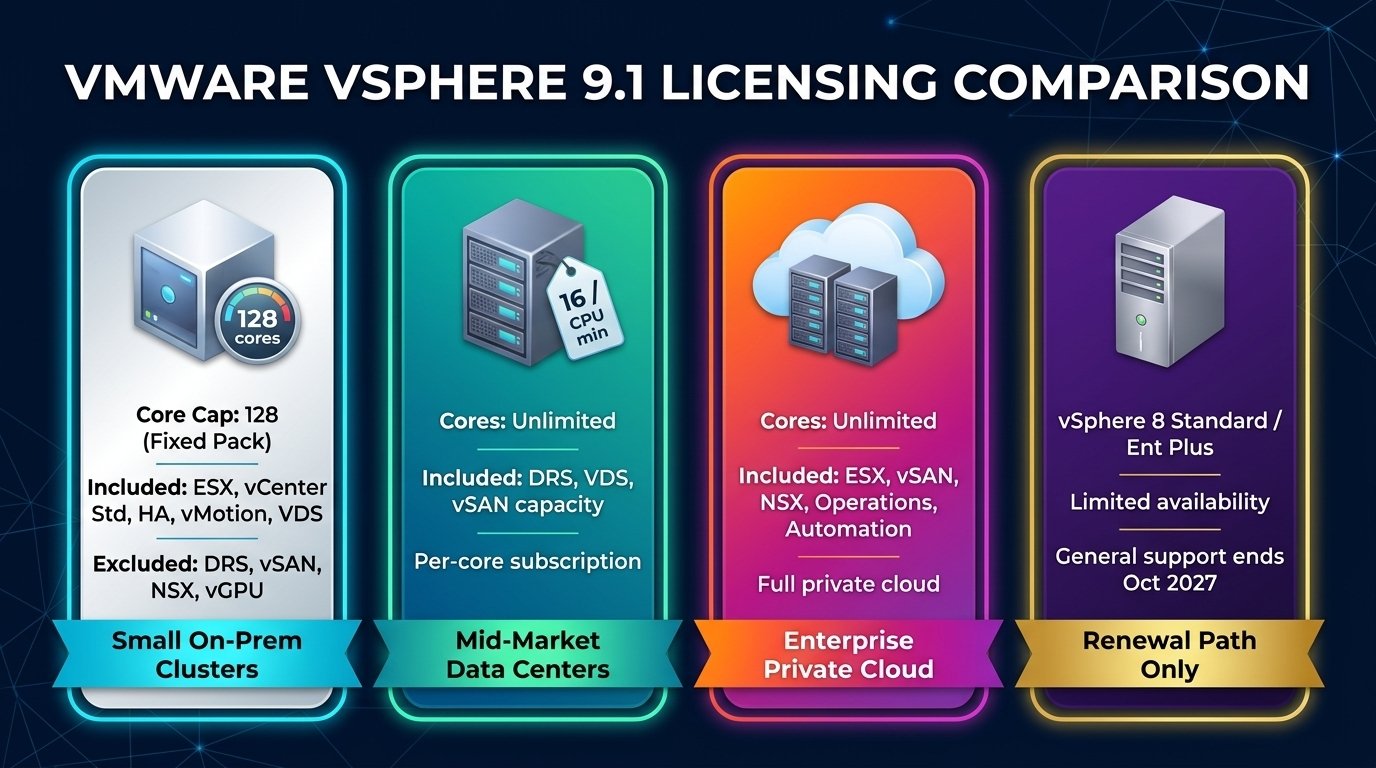
Figure 1: Visual Baseline for VMware vSphere 9.1 Licensing tiers, hardware boundaries, and architectural execution paths.
vSphere 9.1 Express vs. VVF / VCF Core & TCO Estimator
1. Why Broadcom Built vSphere Express
For two years, the small-business message from Broadcom was simple: buy the bundle or go elsewhere. vSphere Express is the first real sign that Broadcom heard the complaints.
When Broadcom finished acquiring VMware, it overhauled the price list. Perpetual licenses ended. The popular vSphere Essentials and Essentials Plus kits, which let a three-host shop run vCenter, vMotion and HA cheaply, were retired. Most customers were steered toward VMware vSphere Foundation (VVF) or VMware Cloud Foundation (VCF), with per-core subscriptions and minimum purchase quantities.
Small and midsize organizations reacted badly. Many saw renewal quotes rise sharply for features they would never use, like vSAN, NSX, or automation suites. MSPs lost customers to Proxmox, Hyper-V and Nutanix. vSphere Express, documented as part of vSphere 9.1, is Broadcom's answer: a single, fixed-size package with the features a small cluster needs and nothing more.
2. What Is VMware vSphere Express?
Think of it as a modern Essentials Plus with a bigger core allowance and a smaller feature set than VVF:
- A fixed 128-core subscription pack. One pack covers up to 128 physical CPU cores across your entire environment. It does not scale down or up.
- Built on vSphere 9. You get the current vSphere 9.x platform, not a legacy 7.x or 8.x branch.
- One SKU, two entitlements. vCenter Standard and ESX (Broadcom has dropped the "i" from ESXi in vSphere 9) come together. No separate vCenter purchase.
- Annual term subscription. Partners and distributors list it at roughly $9,600 per year MSRP. Your actual price depends on your partner and region.
3. What's Included and What's Missing
Express covers the basics of a resilient small cluster well. Anything for automation, scale or AI is left out.
Included: The Essentials
- vCenter Server Standard
- ESX Standard hypervisor
- vSphere Distributed Switch (VDS) Bonus
- vMotion live migration
- vSphere High Availability (HA)
- vCenter Quick Patch
- TPM 2.0 and Virtual TPM (vTPM)
Excluded: The Gaps
- Distributed Resource Scheduler (DRS)
- Memory Tiering and SR-IOV
- vGPU / GPU virtualization
- Proactive HA and Live Patching
- VCF Automation and Private AI
- Centralized multi-instance management
Why the Distributed Switch matters
VDS used to be an Enterprise Plus feature. Having it in an entry-level SKU is a real benefit. You configure port groups, VLANs, NIC teaming and MTU once in vCenter, and every host gets the same settings. That removes a common cause of vMotion and HA failures in small clusters: one host whose standard vSwitch doesn't match the others.
What losing DRS means day to day
Without DRS, vSphere won't balance VMs across hosts or move them off a host automatically during maintenance. HA still restarts VMs after a host failure, but where they land isn't optimized. With three or four hosts, most admins can handle this with occasional manual vMotion. For larger or busier clusters, it adds up.
Where vGPU and AI fit
Without GPU virtualization, VDI with graphics acceleration, CAD workstations and on-prem AI inference are not supported. If any of those are on your roadmap, Express is the wrong product.
4. The Catch: Fine Print You Need to Read
5. Comparison Matrix: Express vs. Standard vs. VVF vs. VCF
| Capability | vSphere Express | vSphere Standard | vSphere Foundation (VVF) | Cloud Foundation (VCF) |
|---|---|---|---|---|
| Licensing Metric | Fixed 128-core pack, annual | Per core subscription (16-core min per CPU) | Per core subscription (16-core min per CPU) | Per core subscription (16-core min per CPU) |
| Maximum Cores | 128 (hard cap) | No cap | No cap | No cap |
| Included vCenter | vCenter Standard | vCenter Standard | vCenter Standard | vCenter (multi-instance, linked) |
| High Availability (HA) | Yes | Yes | Yes | Yes |
| vMotion | Yes | Yes | Yes | Yes |
| Distributed Switch (VDS) | Yes | No | Yes | Yes |
| DRS | No | No | Yes | Yes |
| vSAN / Storage | None (bring your own SAN/NAS) | None | vSAN capacity included (per-core TiB allowance) | vSAN capacity included (larger per-core allowance) |
| Networking & Security | VDS only | Standard vSwitch | VDS | VDS + NSX overlay |
| Target Organization | Small sites, 2 to 4 hosts | SMBs needing basic HA (availability varies by region) | Mid-market data centers | Enterprise private cloud |
Note: Broadcom changes SKU availability, minimum core quantities and vSAN per-core allowances by region and over time. Check the current Broadcom product guide or your partner before you buy.
6. Visual Baseline: VMware vSphere 9.1 Licensing Comparison
To help engineering and infrastructure leadership quickly evaluate fit, the breakdown below illustrates how vSphere Express 9.1 positions across the current VMware ecosystem alongside vSphere Foundation (VVF), VMware Cloud Foundation (VCF), and legacy standalone tiers:
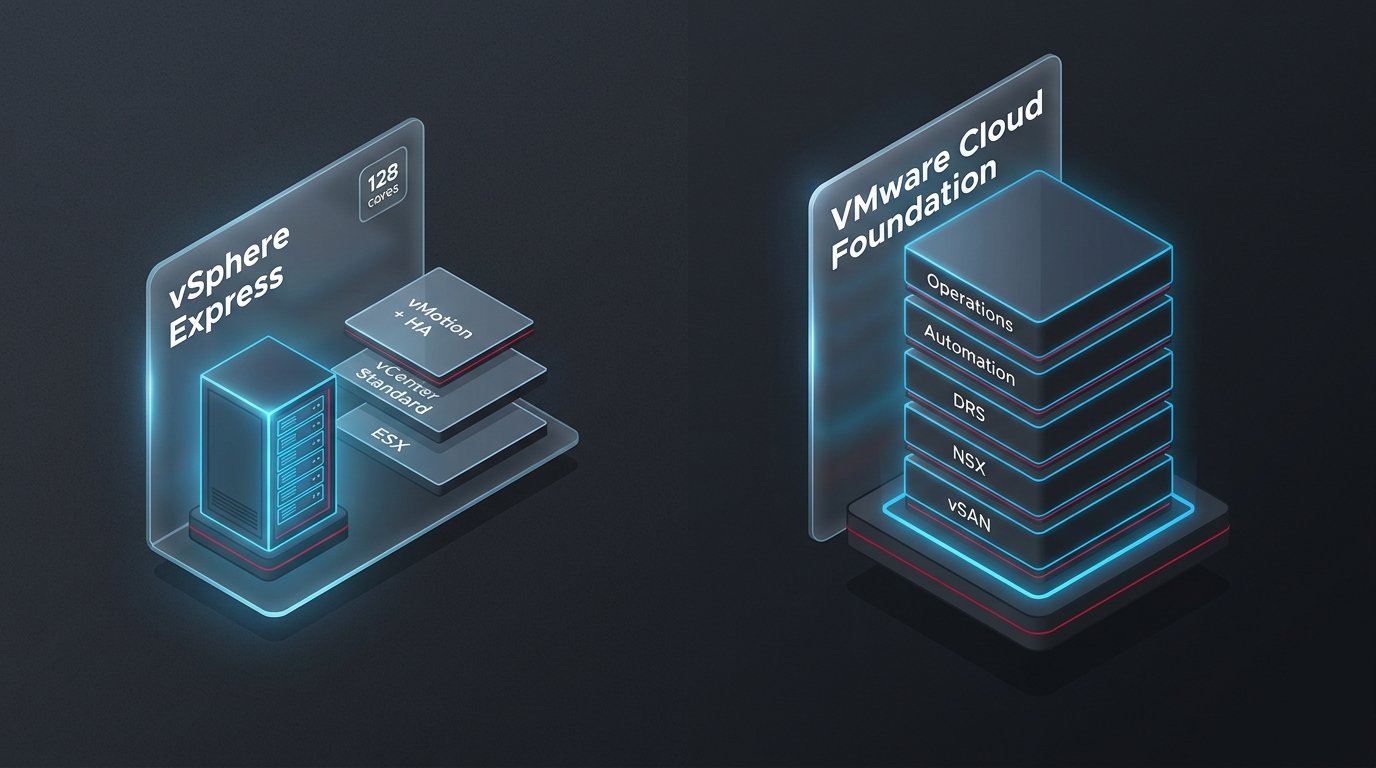
Figure 2: Express is the compact core (ESX, vCenter Standard, vMotion and HA) vs. VCF as the full private-cloud stack.
7. Final Verdict: A 3-Point Decision Checklist
Express isn't a VVF replacement, and that's intentional. It's for small, steady clusters that need HA and vMotion and don't want to pay for a private-cloud stack. Use this checklist to decide:
Buy Express if…
You run 2 to 4 hosts with 128 cores or fewer, already have shared storage, mostly care about HA and vMotion, don't need GPUs, and are eligible as a new or returning customer. If your footprint is near 128 cores, it's likely the cheapest way to stay on VMware.
Stay on (or move to) VVF if…
You depend on DRS, want vSAN instead of a separate array, expect to grow past 128 cores in the next 12 to 24 months, or need Aria Operations-style monitoring. Moving to Express would mean giving up capabilities and possibly migrating twice.
Evaluate alternatives if…
You are well under 128 cores (paying for unused cores), you need vGPU for VDI or AI, or you don't trust long-term pricing. Proxmox VE (low cost, open source), Hyper-V / Azure Local (good if you're a Microsoft shop), and Nutanix AHV (HCI with built-in storage) are the most common landing spots.
Bottom Line
vSphere Express brings back a credible entry-level VMware option for small data centers. It includes the Distributed Switch as a bonus, keeps HA and vMotion, and comes in one simple SKU. The fixed 128-core pack and eligibility rules mean it only works well for a fairly narrow set of customers. Count your cores, price your storage, check eligibility with your partner, and then decide.
8. Frequently Asked Questions (VMware vSphere Express 9.1 Licensing)
What is the VMware vSphere Express license in vSphere 9.1?
VMware vSphere Express is an entry-level annual subscription bundle introduced by Broadcom in vSphere 9.1 for small data centers and edge sites. It is sold as a single fixed 128-core pack that includes both the ESX hypervisor and vCenter Server Standard, along with vSphere High Availability (HA), vMotion live migration, and the vSphere Distributed Switch (VDS).
How much does VMware vSphere Express cost per core?
Distributor and partner pricing places the VMware vSphere Express 128-core pack at approximately $9,600 per year MSRP. If you utilize all 128 physical CPU cores, the effective cost is roughly $75 per core per year. Because the pack is fixed-size, running fewer cores (such as 64 cores) still costs the full 128-core pack price (~$150 per core effective).
Does VMware vSphere Express include DRS, vSAN, or vGPU?
No. VMware vSphere Express excludes Distributed Resource Scheduler (DRS), vSAN software-defined storage, vGPU/GPU virtualization, Memory Tiering, SR-IOV, Proactive HA, and Live Patching. Customers must use external shared storage (iSCSI, NFS, or Fibre Channel SAN/NAS) and manage VM placement across hosts manually.
Is vSphere Distributed Switch (VDS) included in vSphere Express?
Yes. Unlike legacy vSphere Essentials Plus or vSphere Standard (which only included Standard vSwitches), vSphere Express 9.1 includes the vSphere Distributed Switch (VDS) for centralized VLAN, MTU, and NIC teaming configuration across the cluster.
Can you stack multiple vSphere Express 128-core packs in one environment?
No. VMware vSphere Express has a hard ceiling of 128 physical CPU cores per environment and does not include centralized multi-instance management. Environments requiring more than 128 cores, automated vSphere DRS, or vSAN ESA storage must license VMware vSphere Foundation (VVF) or VMware Cloud Foundation (VCF).
Who is eligible to buy VMware vSphere Express?
Partner guidelines indicate that vSphere Express is primarily targeted at net-new VMware customers or returning customers who have been inactive for a qualifying period (commonly cited as 3+ years), often subject to Broadcom deal approval. If Express does not fit your footprint, review our ESXi vs. Proxmox vs. KVM Hypervisor Comparison.

Written by Moinul Haque
Practicing infrastructure architect documenting VMware systems engineering, licensing strategy, and production hypervisors.